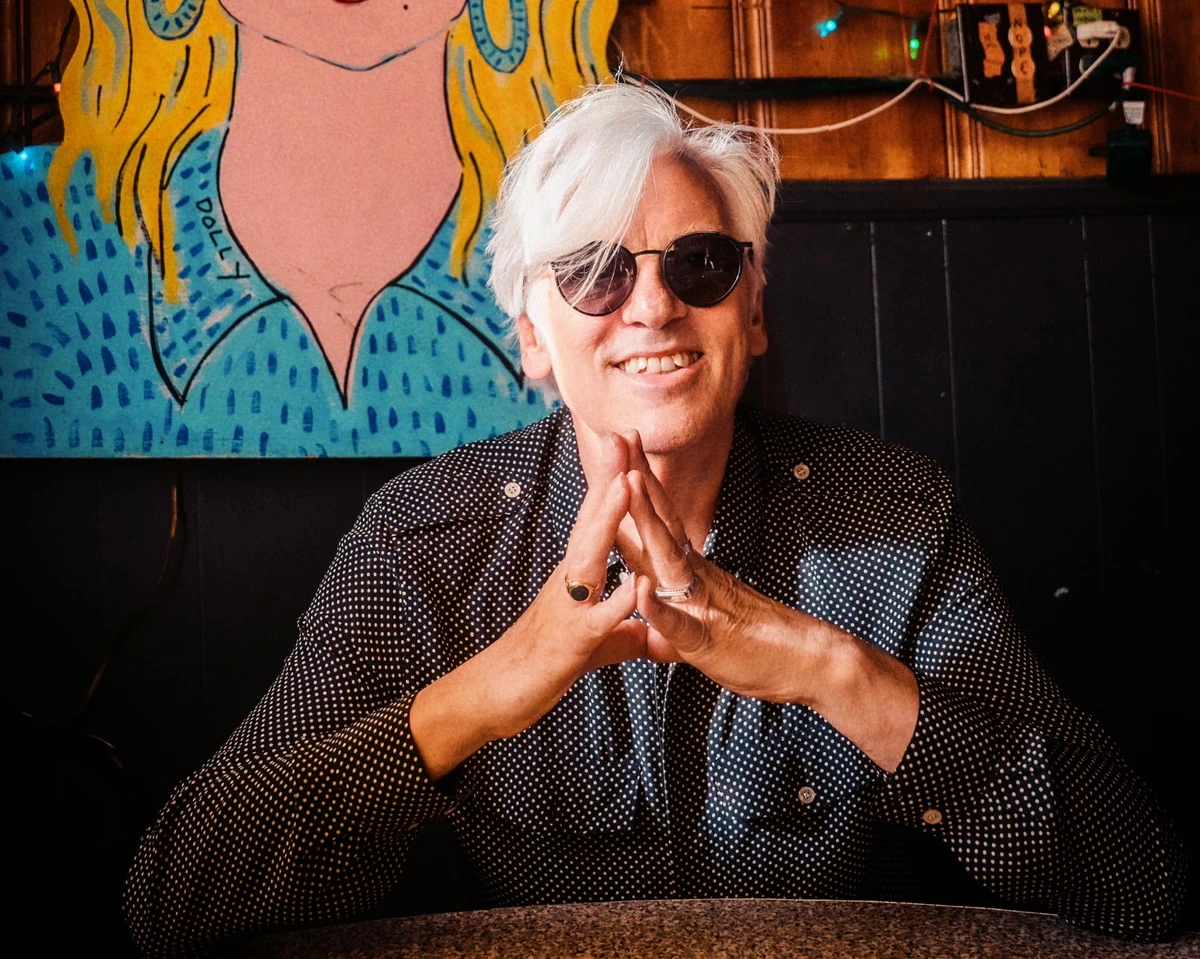
‘I owe a lot to a dead man’s cock.” So begins the first song, a propulsive piece of Lennonesque powerpop called I Am This Thing, on The Confuser, the latest album by the 73-year-old English gentleman survivor of the 60s/70s frontline, Robyn Hitchcock. The album has been recorded by a crack team of session guys in Nashville, where Hitchcock lives and runs a boutique record label with his second wife, the Australian singer-songwriter Emma Swift.
“I’m not just some sort of old public school dilettante floating around the South Bank or whatever,” Hitchcock protests, unbidden. “Making it work in Nashville means I actually am a real musician songwriter in the real musician songwriter town. And I think, ‘OK, I actually did do this!’ I wanted to go to Nashville when I, as a 13-year-old boarding school boy, heard those Dylan records he made here. And a mere 60 years later, here I am!”
Hitchcock, in his sixth decade of songwriting, is very much alive. The dead man to whom he is indebted, meanwhile, is presumably Hitchcock’s father Raymond Hitchcock, a bohemian artist and satirical novelist. And the penis in question, I assume, is either Raymond’s, which co-spawned Robyn. Or else it’s Percy, the eponymous penis hero of one of Raymond’s novels, subsequently filmed with Hywel Bennett and soundtracked by the Kinks. It’s not made entirely clear, and the possible double reading is totally typical of Hitchcock’s tricksy refusal to be transparent. But we’ll get to that.
There’s a framed poster for the Italian dub of the film on the right behind Hitchcock as I talk to him via video call. “Yes,” he explains in that compressed voice, one that seems designed to penetrate your forehead, “the Italian version was called Il Complesso del Trapianto, The Complications of Transplants. And the poster shows Hywel Bennett looking down at an extremely high mound under his sheet in the presence of a scantily clad nurse.”
On Hitchcock’s left is another framed print, a rainbow-tinged silhouette of Bob Dylan dissolving in Duchampian shadows by Milton Glaser. Hitchcock has arranged the two images perfectly, a summary of the influences that shaped him. As his first memoir, 2024’s engrossing 1967, details, the young Hitchcock, taking inspiration from a hip older beatnik boy called Brian Eno, got all the musical tools he needed in one year – Pink Floyd’s burned-out founder Syd Barrett, acid-folk avatars the Incredible String Band, the psychedelic-era Beatles, and Dylan – and he’s spent his life honouring his teenage taste by endlessly recombining those canonical sources.
“Although my prime influence was Bob Dylan,” Hitchcock says, “and Dylan showed me what I wanted to be, Syd Barrett showed me how I could be it. And I actually wound up sounding like John Lennon. To me, the Beatles are at the beginning and the end of everything. But my role has always just been to carry on a certain kind of music, which appeared in 66 and 67. My influences are all those old dead English blokes, basically.”
I put it to Hitchcock that he is the last old dead English bloke who isn’t actually dead. “Well, I’m the last high-functioning one,” he laughs in agreement. “I mean, there’s Julian Cope and Andy Partridge of XTC, but they’re out of commission for playing live. But you can go and see me. I didn’t invent this field of music, but I’ve perpetuated it. I wanted to maintain a tradition and do new work in that tradition. But the guys I worship were innovators. I’m the opposite. I’m sweeping up after them. It’s like, ‘Oh God, here comes Hitchcock with the broom.’”
Hitchcock sells himself short of course, but deliberately so I imagine. No horses will be spooked by The Confuser, a comfortable sock of an album that Hitchcock the eternal disruptor has earned the right to slip on at this stage, though he still attempts to force his way into areas he’s never explored before. On the new album, those Nashville cats find a walking bass and cowbell groove on My Dead Astronaut that swings in the way this septuagenarian hasn’t before; Hitchcock’s 70s collaborator Kimberley Rew adds a typically luminescent guitar to the shimmery Breathless; Building from the Ruins is a white funk workout; Monday for Me is a waltz-time folksy critique of the working week.
Hitchcock’s peculiar vision was an awkward fit for his punk-era debut, as frontman of Cambridge’s the Soft Boys, who despite being raucous and ragged, displayed enough pop classicism and ostentatious intellectualism to displease equally middle-class journalists who were in search of noble rock savages. The contradictions of the time are detailed in Hitchcock’s latest volume of memoirs, the typically evasive Stranded in the Future. It’s a writerly work where the personal and the painful are sublimated and stories are chosen for their poetic, rather than their literal, truth. (Did homeless Cambridge mystics really participate in an early Soft Boys recording session?) It reads as a fascinating piece of unreliable-narrator fiction, whether you are interested in Hitchcock’s music or not.
“Some of it technically couldn’t have happened at all,” Hitchcock agrees. “But that’s to do with my capacity to embrace delusion. And my tendency to create my own personal myth. You mythologise your life and then you can plunder it for songs or jokes or stories or whatever.” I remind Hitchcock of a time we were standing on Westminster Bridge when two elderly ladies approached and asked us for directions. And he answered them in such a flamboyant way they left clearly delighted at having met this dapper and eloquent man, who was surely someone significant, and who even questioned whether they really needed to go to the place that they were looking for anyway. Was he aware of having created a moment?
“Oh no, not really,” Hitchcock reflects. “But I think I just rise to the bait of attention, don’t you? Oh, jolly good. Someone wants me to perform.”
“I don’t know that they did,” I offer. “They just wanted directions.”
“Yes, but I wanted an excuse to perform and two kindly old ladies have turned up. Now’s my chance.”
Hitchcock has mastered the public mask then, but in the new memoir the younger man is separated socially and emotionally from people, and aspects of normal human behaviour baffle him – yet these problems become strengths of the work. “It seems like estrangement is an essential part of the journey,” Hitchcock concedes. “It doesn’t give you carte blanche to be an asshole, but you’re liable to be one in the course of it. There’s also a degree of narcissism that is on some level necessary.”
In one section of the book, the young Hitchcock writes a nasty song about the elderly neighbours complaining about the punk noise of the Soft Boys’ terraced street rehearsals. “I was a self-centred, entitled little horror and arguably I still am. I’ve just learned to mask it more, and also I’ve learned to make a living out of it.”
Now the specifics of punk’s particular culture wars are a distant memory, the Soft Boys’ second album, 1980’s Underwater Moonlight, subsequently hugely influential on the American indie scene of the 1980s, has emerged from the haze of battle as an all-time classic, like the shell-shocked figure of Private William Pennington stumbling out of the canvas of Lady Butler’s Balaclava. Hitchcock had a good late 80s and a better early 90s, reconvening fragments of the Soft Boys as Robyn Hitchcock and the Egyptians, getting a major label deal with A&M, and becoming a kind of accidental college rock star in America, feted by REM and the Replacements, and scoring actual hits such as Balloon Man (which Hitchcock says he would “be happy to never hear again, although I do like the money I get from the royalties”) and the irresistible Byrdsian head rush of So You Think You’re in Love.
“It’s funny when people think of me as an 80s artist,” Hitchcock reflects, “because I think of myself as a 60s artist. I literally am the last to hatch out, I think. I should be in a museum with Ron Wood. I was never actually a pop star. I was on MTV quite a lot in the States in the late 80s and early 90s, but that’s a long time back. I always manage to dodge the extreme limelight. You know, in some ways I’ve avoided both success and failure. It’s fantastic. And it’s always a bit of a shock when somebody identifies me. Mostly they think I’m Nick Lowe, which is great. But then occasionally people then think Nick is me. I’ve signed an autograph as Nick Lowe once or twice.”
For me, the albums from Hitchcock’s MTV era, Globe of Frogs and Perspex Island, now seem cluttered by the cacophonous production ethos of the times and, the acoustic outlier of 1990’s mesmerising Eye aside, Hitchcock hits his stride in the late 90s when the director Jonathan Demme, a fan who subsequently cast him in The Manchurian Candidate, shot him in a low-key trio for a concert film, Storefront Hitchcock. The show seemed to presage a path of greater musical clarity, resulting in nearly three decades of great solo releases. But Hitchcock’s work, though often inexplicably moving, remains emotionally opaque.
What did Hitchcock mean when he wrote, 48 years ago, I Want to Be an Anglepoise Lamp? Does the toy town psychedelia of 1981’s The Man Who Invented Himself refer to its writer? Who is the eponymous subject of 1990’s Zen ballad Cynthia Masque, its lyrics ranging voraciously through history? In contrast, 1984’s blunt Uncorrected Personality Traits, a simple a cappella list of psychological conditions in adults and their roots in childhood experiences, is uncommonly direct. In the memoir 1967 Hitchcock was finally to concede, 57 years later: “I [was] what would in the 21st century be called ‘on the spectrum’, at the high-functioning end of autism.”
So is rock’n’roll where Hitchcock hides? “I’m not a conventional soul-barer. I’m probably more interested in creating a version of my existence than actually showing people the real Robyn. Maybe there isn’t a real Robyn. Someone described me as ‘the Peter Sellers of rock’, which I took as a compliment. I did have a therapist once who said, ‘You’ve really built some place to hide and it’s extremely difficult to get at you,’ which I thought was interesting.
“In the new book, I talk about my first concept for the Soft Boys, which was to build a robot that would front this band and I would be the guitarist. And the handsome robot would be singing my lyrics and people would go, ‘Oh, isn’t he wonderful’?” But now you are the robot? “Well, I became the robot because I didn’t have the technical abilities to make one. But that’s an interesting thing. It’s like, ‘What is there about me that seeks attention but then doesn’t actually want to give anything away?’”
Personally I’m glad that Hitchcock, at 73, is yet to close that contradiction, even though, as Stranded in the Future often inadvertently reveals, it’s a condition that has made life difficult for him, and the people in his orbit or perhaps, more accurately, in his wake. It’s what makes Hitchcock so much more than simply the sum of the carefully balanced influences he chose as a teenager in 1967. Long may he remain unresolved.
The Confuser is released via Tiny Ghost records on 24 July. Robyn Hitchcock tours the UK and Europe from September