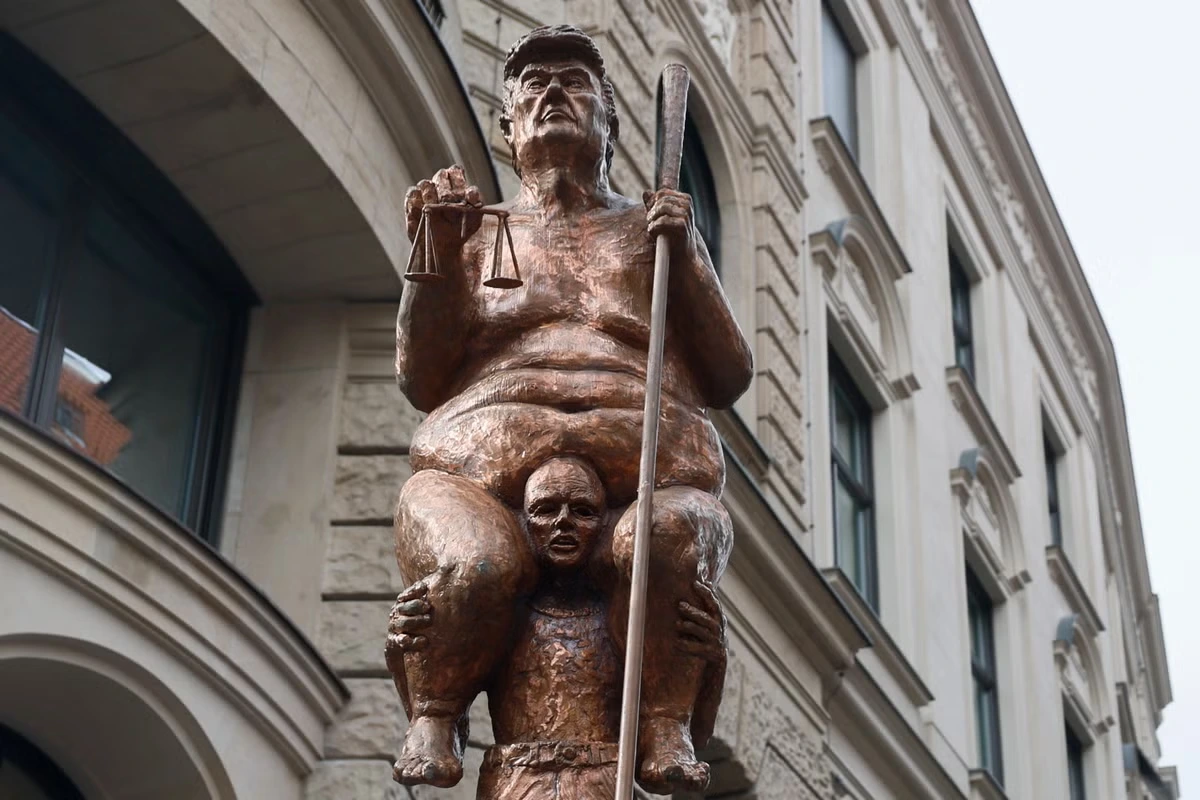
You probably shouldn’t read too much into this, but the European Parliament, a co-partner in the governance of the greatest trading bloc on earth, has unveiled a grotesque statue of a nude Donald Trump, complete with moobs, golf club and outsize rump, sitting on what looks to be a teenage boy.
It will adorn the parliament building in Strasbourg, and called The Orange Plague. Like the one that will no doubt dominate the foyer of the future Trump presidential library, the monument is gold. The presidential member – memorably compared by Stormy Daniels to a toadstool – is obscured by the head of the other figure.
This disturbing creation, entitled “The King of Injustice” hardly needs much explanation, but the Danish artist, Jens Galschiøt has added a helpful inscription on the plinth: “I am sitting on the back of a man. He is sinking under my burden. I will do anything to help him. Except stepping down from his back.”
Fair enough, and it does capture that mix of mutual frustration, resentment and alienation that characterises the transatlantic partnership these days, a childish riposte to the juveniles in the Trump administration who deride faithful allies as being in a state of “civilisational erasure” and not worth defending.
It is thus an appropriate, if distracting, metaphorical backdrop to the latest Anglo-German summit, in Berlin.
When the UK was in the European Union, it was to the Germans, rather than the French or the EU Commission itself, that the British usually appealed to when they needed some assistance.
It didn’t always work. The most ill-fated example was when the then prime minister, David Cameron virtually begged Angela Merkel to do some favours with his “renegotiation” of the British terms of membership of the EU. It was not forthcoming. Not since Neville Chamberlain crossed the Channel in 1938 did a British leader return with less to show for his diplomatic efforts.
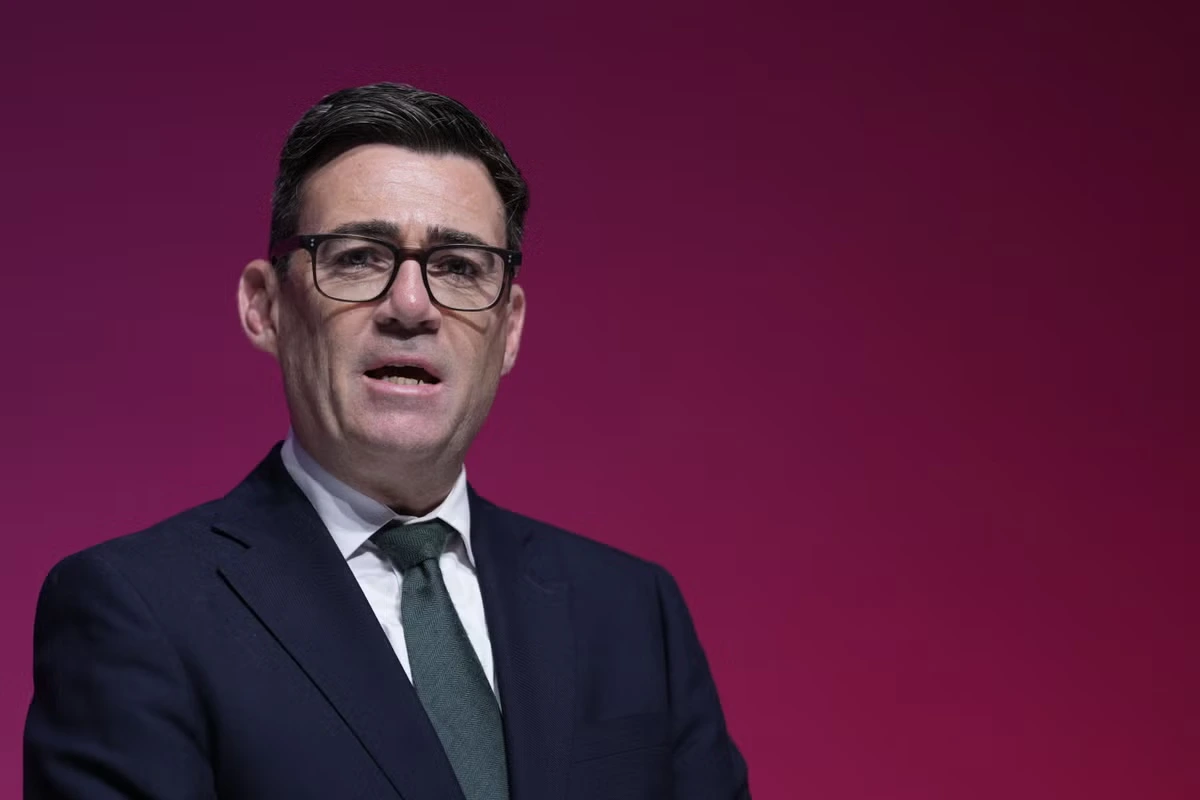
Perhaps Andy Burnham will be more lucky. The geopolitics are certainly more favourable to closer cooperation since Brexit. Russia has gone beyond attacking its neighbours and indulging in casual interference in other countries’ politics and into what’s called “hybrid” warfare.
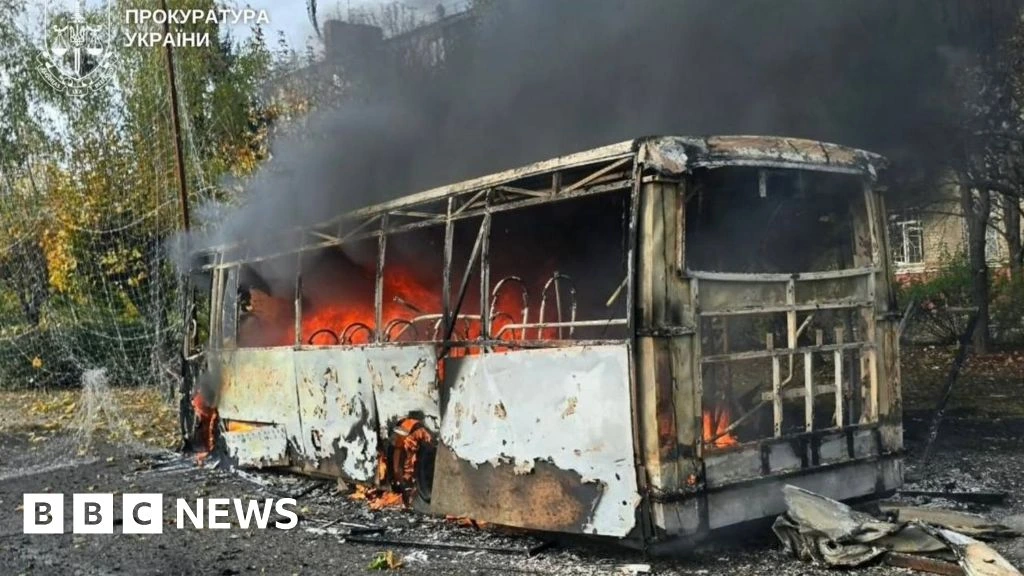
Not so long ago a drone attack on a Ukrainian plane at Leipzig airport was narrowly foiled; and we all recall the bizarre tale of the Russian agents paid to firebomb Keir Starmer’s family home. Hardly a day goes by without some stray Russian missile or drone straying “accidentally” into Nato airspace or landing in the borderlands of Poland, Romania and the Baltic republics. We are constantly probed and harassed by the Russian “shadow fleet” surveilling or “inadvertently” dredging up vital communications and energy infrastructure on seabeds across Northern Europe.
All this is, of course, in the context of explicit US disengagement from Nato and its European commitments, successive rounds of a trade war being waged by the White House on its Economic partners, and a war of words and insults of which Jens Galschiøt’s sculpture is only the latest.
In finer words, even if the British and the Germans didn’t want to work together in their own national interests they would be compelled to do so by the changing balance of power within the European continent and around it. More than ever, the interests of all the major European powers are being aligned for them.
The Europeans need the British for purposes of defence and security in a way that was not (but should have been) foreseen at the time of Brexit, to resist Russian revanchism, a more assertive China and an openly unreliable America.
As is all too evident, Brexit has not yielded a new role for Britain in the world as a prosperous beacon of free trade, and it needs to restore its growth prospects and access to its largest and most potentially accessible market for goods and services. As the old Remain campaign slogan had it, the UK is stronger in, and Europe is stronger with the British inside the tent.
The message of the French finance minister, Roland Lescure, a welcome noise off during the Berlin summit, to the British people is “come back, anytime”.
But it is not Lesvure, or Friedrich Merz or even Burnham who is propelling the UK back into the EU but the combined efforts of Vladimir Putin and Donald Trump that are making the case for a stronger united Europe that can protect its own interests.
With such centripetal forces at work, there is, in other words, something inevitable about the integration of the continent’s nations, whatever the outcome of periodic summits and “reset” meetings may be. We’re being pushed together by much bigger forces, whether we like it nor not.