In March 2020, when the mayor of San Francisco instructed all citizens to remain in their houses due to a pandemic, the first thing I did was order all the books of Agatha Christie. I was not alone; I think many of us immersed ourselves in reliable narratives to drown out the chaos. It did not matter if it ended in marriage or murder; the reliability was what mattered. Later when I realised I would need to hole up for some time, my reading shifted to a different kind of novel. And because, like Christie, our world has an endless supply of new terrors, it is the comic novel that still fills my reading hours.
Nobody knows what a comic novel is. And once you start discussing it, all the fun runs out. EB White compared it to dissecting a frog (you’re left with innards and a dead frog) but I would compare it to turning all the lights on at a party: everyone looks terrible and you’ve ruined the party. Most would agree, of course, that Wodehouse wrote comic novels, but I turn to books hardly anybody would classify that way – Moby-Dick by Herman Melville, for instance – that yet seem to me to be a hoot. I think they are books that decide something is funny, as Jerry Seinfeld once defined comedy. In Moby-Dick, it’s a coin nailed to a masthead. In Vladimir Nabokov’s Pale Fire, it’s the worst best poem you’ve ever read. And yet we feel we’re getting at something the most solemn narratives aim for: an understanding of the human condition, of grief, of love, of death. All the big stuff. The comic novels I love are books that could just as easily have been tragedies. It is simply that the author has decided it’s funny.
It’s something I learned from a wise friend of mine who once, after I angrily related a publishing story of mine, responded: “That’s not a very funny story.” I was shocked. And then I understood that I had not processed the story at all, and was serving this dish to her raw. I had to learn to turn an old outrage into a funny story. And then she would be willing to listen. I did learn to do this. And I have put the very scene I have described to you into my latest novel. A comic novel, if you like.
I have written both comic novels and novels where you would not crack a smile – serious novels, I suppose. And I can relate that, for me, writing the comic ones is a much more pleasant, though very different, kind of work. But the plots are no funnier than the serious ones. See if you can guess which one is comic and which is serious:
A young woman in 1952 San Francisco joins with her husband’s gay lover to remove obstacles to her liberation and gain a small fortune.
A middle-aged writer travels across a troubled United States while struggling to maintain his recently renewed relationship with a younger man.
Even if you guessed, you see my point: I have to decide it’s funny. And that takes double-processing. Like blond hair at the salon. First, I work out the hardships and frustrations of the characters as realistically, even tragically, as possible. People die in comic novels. Sometimes the world ends, or sometimes just the world we thought we knew, and I have to consider the real reactions of my characters because, after all, they don’t know it’s a comedy. Second, I begin to write it as if it’s all just a funny story. That takes a great deal of struggle and sometimes feels impossible.
In my last novel, Less Is Lost (that’s the one about the middle-aged writer), I found myself sitting with my notes on visiting three forced labour plantations in the American south. There was nothing humorous about them, yet I didn’t want to cut them; I knew my protagonist had to confront that part of American history. But then I read over the notes of my final visit and realised that I was the comedy: myself and the other white visitors, showcasing our guilt and anxiety through statements that were utterly absurd. In fact, I ended up portraying the visit almost exactly as I had it in my notes … but with a different emphasis. Is it “funny”? No. Is it “comic”? Definitely. Why? I don’t know. I don’t know. I can’t explain it any better for fear of turning on the party lights.
In writing my latest novel, Villa Coco, I had a much easier time, since I was working off notes in my diaries from my time living in Tuscany, and those notes were already blond hair in a salon; I made a promise to myself that I would turn each day’s events into a “funny story”. And yet, in a way, I found myself sifting through these stories for the other thing: the real feeling. Because there was the death, in those days, of a dear friend. A turn of seasons. A broken heart. All the things I would have previously put down in my diary now had been expunged, and though I had processed them into lovely stories, the job (as a novelist now and not a diarist) was to get to the hardships and frustrations of my characters. Because, to me, comedy is only great fun if it is about something hard and true.
“I don’t think of you as writing a comic novel,” a writer friend told me. “I think of you as working through something in whatever way you have to.” He meant that my books are not “about” women in 1952 or middle-aged writers or olive harvests in Tuscany. They are about marriage and growing old and the terror of death. It is just that, in a comic novel, those issues are temporarily resolved, often in a flagrantly artificial fashion. As if to say: life is a vale of tears, and there’s no fixing it, but just for fun let’s fix this one small piece. Let’s decide, briefly, to lift the weight of being. You can’t successfully do that, I think, without being honest about it first.
And yet – what a lovely time I have working on these books. Because everything has to be processed in this way, each awful moment of the day becomes more material for comedy. Thus I become, somehow, more resilient; a trip on the sidewalk is no less embarrassing than before but, instead of trying to play it off, I laugh with anyone who notices (and people do notice). What would normally be a dull wait at a bus stop (or a mind‑numbing trip through the internet) becomes a delightful experience with my notebook. “Cheese rolling contest May 20,” I might copy down from a poster, “Prize is the wheel of cheese.” Or “lady in black sequined dress yelling at a mailbox at nine in the morning. I think she mailed her purse by mistake.” I am not a person who particularly lives in the present tense, but comedy forces me there. A good place to be.
Language also achieves a new richness. People assume writers think about plot or characters, in the way they assume painters or photographers think about their subjects. But painters think about paint. Photographers think about light. And writers think about words. There is something so utterly delicious about being able to make use of words that are otherwise forbidden to touch. I don’t mean curse words; I mean fancy ones. Take for instance something like “noise”. In a serious novel, you would have to say “down the street came a noise”. Anything more elaborate would be a red flag of pretentiousness. So you settle for the austerity of “noise” and move on. But when writing comedy, suddenly a whole feast of words is spread before you: hullabaloo and brouhaha and hubbub and chivaree. Chivaree! Banging pots and pans together to publicly shame a citizen or tease a newly married couple! What a word! My language has not become simpler by writing comedy; it has become zestier. And if, like me, words are your favourite medium, it is akin to tomatoes finally coming into season after months of cabbage and kale.
No wonder what some consider the very first “novel” was one of the most rip-roaring, slapstick comedies around: Don Quixote. Chaucer himself was not above a fart joke, and Shakespeare could never resist a pun. There is a grand tradition, in fact, of great writers dabbling in comedy – Philip Roth, Saul Bellow, Thornton Wilder – and I think there is something about having seen the darkness that pulls so many to laughter. Certainly, in these difficult times, with endless apocalyptic films and novels appearing, many of us find ourselves picking up Stella Gibbons’ Cold Comfort Farm instead.
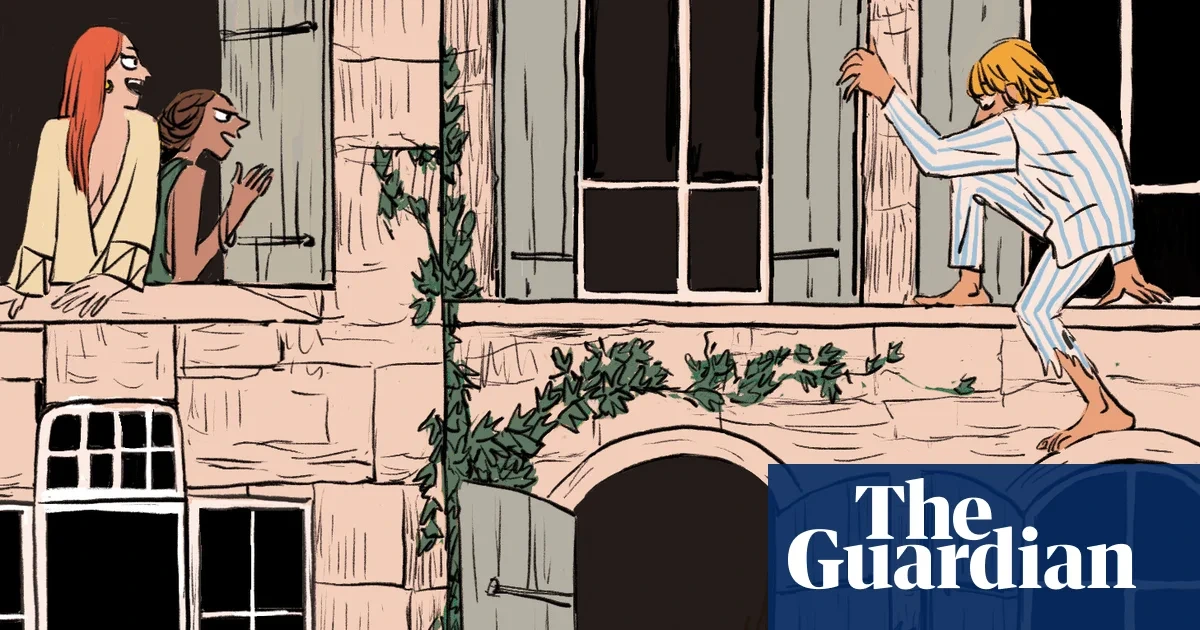
There is something dear and beautiful about the comic novel, something to love. A friend to hold your hand when the lights flicker out and tell you a story until they come back on again. And, for those of us who write them, a way to feel our way forward down the tunnel into the light. I know that it was a solace to imagine a much younger American man, finding himself delivered to a rural Tuscan train station that he says is “so fanciful one might unwrap it and find it was chocolate”. And to be seated next to a princess who cannot understand him because she has not mastered “the American dialect”. And throw a wild animal into his window at night. And make the septic tank overflow. All to get at a simple truth: the world is trouble, and full of sorrows, and we will not get out alive.
But look closely: it is, in fact, made of chocolate.
Villa Coco by Andrew Sean Greer is published by Sceptre. To support the Guardian, order your copy at guardianbookshop.com. Delivery charges may apply.
Ten novels to make you laugh
Cold Comfort Farm by Stella Gibbons
This is a satire of a genre that no longer even exists (the rural English romance) because it erased it with its perfect sense of humour.
Pomp and Circumstance by Noël Coward
The queen is coming to visit a far-flung island nation and everyone is aquiver.
Pnin by Vladimir Nabokov
The poignancy of Nabokov’s tortured Russian academic makes one fall in love with poor Pnin.
Bech: A Book by John Updike
The first of a series of books about a Philip Roth-like novelist adrift in the world. Like Nabokov, a wordsmith having great fun with the English language.
The Sellout by Paul Beatty
A brilliant example of taking the most serious of subjects – slavery in America – and turning it completely on its head.
I Capture the Castle by Dodie Smith
I reread this book annually and both laugh and shed tears over the fate of our teenage narrator, Cassandra, whose diary this is.
Our Man in Havana by Graham Greene
Personally, I prefer Greene’s “entertainments” to his serious fiction, from Travels With My Aunt to this wonderful case of mistaken identity.
Little Me: The Intimate Memoirs of That Great Star of Stage, Screen and Television, Belle Poitrine by Patrick Dennis
From the writer of Auntie Mame, a deliciously deluded memoir of an absolute nobody, complete with photographs!
The Pursuit of Love/Love in a Cold Climate by Nancy Mitford
Eccentricity and delight mix with heartache in this classic fictionalised version of her famous family.
Don Quixote by Miguel de Cervantes
Hilarious from beginning to end, and the sequel is even better, because suddenly Don Quixote and Sancho Panza are famous because everyone has read the first.